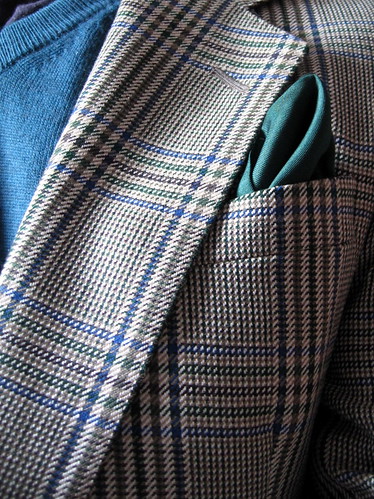
Beth recently sent me an email requesting a tutorial on fashion terms. This can be a tricky thing to do, because while there are some absolutes, often the definition of a fashion term is dependent on whom you are asking. Also, lots of garments, shoes, handbags, etc. fall in between certain categories, or a term we've long known to describe one aspect of a garment, suddenly describes something else. Designers and fashion trends sometimes require the invention of new terms that are used to describe a slight variation on a term we already know. However, despite these challenges, I'm going to do my best to put together some basic terms and their definitions to help you understand the often confusing fashion world. I'm going to attempt to cover silhouette, neckline, fabric, and the elements of garment construction, specifically geared towards women's clothing and accessories. Maybe if this post is popular (and not torturous for me to write), I'll do a menswear version.
A-line- A skirt or dress silhouette in which the waistline is narrow, extending to a fuller skirt in the shape of the letter "A."
Almond Toe- The tip of a close-toed shoe that is a rounded point, like the tip of an almond.
Ankle boot- A short boot that extends up to, but not beyond the ankle.
Ankle Wrap/Ankle Strap- A shoe whose closure includes a wrap around the ankle or a strap that fastens around the ankle.
Applique- A method of embellishing a garment by stitching pieces of one fabric onto another. The pieces are often referred to as "appliques," but the term can also be used to describe the technique. Appliques can be plain fabric, but they can also be embellished with beads/sequins, etc.
Baby Doll- A short dress made with an empire waist.
Baguette- A handbag that is small and narrow, like a loaf of French bread.
Ball Gown- A full skirted ball gown, often with crinoline to hold the shape of the skirt. A true ball gown will have pleats or gathering at the waist which helps to give it the extremely full shape.
Bandeau- A strapless, straight band across the bust.
Barrel Bag- A bag with a horizontal cylindrical shape.
Basque Waist- A waistline that dips into a "V" shape in the center.
Bateau or Boat Neck- A high neckline that runs almost straight across in front, back or both from shoulder to shoulder.
Batwing or Dolman Sleeve- A sleeve with a wide opening at the shoulder that tapers in at the wrist. This type of sleeve often has an opening that runs from the shoulder to as low as the waist or bottom of the blouse.
Bellows Pocket- A pocket with extra folds of fabric along the sides and bottom, so that they can expand. Most commonly used on cargo pants and sporty clothing.
Bias- Fabric that is cut diagonally across the grain of the fabric.
Bishop Sleeve- A long sleeve that is fuller at the bottom and gathered together into a cuff at the wrist. There can be gathering at the shoulder creating a puffed sleeve, or it can be full only at the bottom. A similar style that has the gathering at the elbow instead of the wrist is referred to as a "Leg of Mutton Sleeve."
Boning- Stiff metal or plastic pieces that run vertically within a gown or corset, providing stiffness to the garment. Originally made with actual bone, hence the term.
Bootleg- Pants or jeans that have a slightly flared opening at the hem to accommodate a boot.
Box pleat (and inverted box pleat)- A double pleat where the two upper pleats face away from each other and the under pleats face towards each other. The opposite is an inverted box pleat.
Brocade- An intricately woven fabric typically made to create a raised pattern. It often appears to be embroidered, but is actually woven, typically on a loom.
Bubble hem/skirt- A hemline in which the top layer of fabric (usually a very full cut) is sewn to the less-full lining with the top layer being gathered together as it is sewn. The effect creates a "bubble" at the hemline.
Bucket Bag- A bag resembling the shape of a bucket, typically with a height that is greater than its width. Can have a round or square bottom.
Cape/Capelet- Sleeveless outerwear that fastens at the neck and extends down from the shoulders. Can be any length from above the elbow to the floor.
Cap Sleeve- A small sleeve that sits on the outer edge of the shoulder. It can also extend just beyond the shoulder, or fall a bit onto the arm.
Chambray- A woven fabric, similar to linen or cotton, but which uses a white weft combined with a colored warp. Blue is the most common color used in chambray, and the result is like a faded, light-weight denim.
Circle skirt- A skirt that is cut literally in the shape of a circle. It creates a very full silhouette, but without any gathering or pleats.
Clutch- A small handbag without a strap or handle, meant to be held under the arm or "clutched" in the hand. Best with evening wear.
Covered Heel- A heel that is covered in the same material as the upper portion of the shoe. Most high heels have a covered heel.
Cowboy Heel/Cuban Heel- A heel that falls straight down in the front, but angles in from front to back at the back of the heel.
Cowl neck-A neckline with fabric that falls very loosely from shoulder to shoulder. It can drape in the front, back or both.
Cross-Body Handbag- A bag whose strap extends over the shoulder and across the body, allowing your hands to be free. Can be as small as a clutch, or large like a messenger bag, and everything in between.
Cuff- A large, rigid bracelet, typically made with an interior closure or opening. Also refers to the folded edge of a sleeve or pant.
Damask- Similar to a brocade in that it is woven and often features intricate patterns and scenes, however, unlike brocade, the pattern is reversible.
Dart- A fold stitched into the fabric of a garment to give it shape. Often found near the bust and waistline.
D'Orsay- A style of shoe where one or both sides are cut away from the center portion of the shoe.
Dropped Waist- A silhouette in which the definition of the waistline falls slightly below the natural waist.
Dupioni- A silk fabric woven from two cocoons which creates a slightly shimmery, sometimes iridescent effect. Similar to silk shantung, with the main difference being silk shantung is made using a single thread or cocoon. Both fabrics are characterized by the "slubs" or the bumps in the fabric, left behind by the silkworms.
Embroidered/Embroidery- A decorative pattern or method of embellishing fabric using thread to create the design.
Empire Waist- A silhouette in which the skirt falls from above the natural waist, as high as directly under the bust.
Envelope Bag/Clutch- A flat handbag with a flap closure that resembles an envelope. Typically it is made without straps and is a type of clutch handbag.
Espadrille- A shoe where the sole is made of jute. They can be flats, wedges or platforms.
Fit and Flare- A silhouette in which the bodice is fitted and flares out into a fuller skirt. Trumpet and Mermaid silhouettes are examples of this.
Flap Pocket- A pocket in which there is a top flap over the opening of the pocket. The flap may sometimes have a button or snap.
Frog Closure- A braided button/loop closure often used as an ornamental style closure. It is most commonly used in Asian-style attire.
Godet- A triangular piece of fabric sewn into a garment to create a flared effect.
Grain- The direction of the weft of the fabric. Cutting "with the grain" refers to cutting in the vertical direction of the fabric (weft). Cutting "across the grain" refers to cutting horizontally across the fabric (warp).
Halter- A neckline style in which a single strap fastens behind the neck.
Handkerchief- A hemline that falls in multiple triangular points.
Haute Couture- Extremely expensive, hand-made, high quality garment. To qualify as "haute couture," a garment must be made following strict guidelines within a certified haute couture house.
Hidden Platform- A platform shoe where a portion of the platform is "hidden" within the shoe under the ball of the foot.
High-Low (or Hi-Lo)- A hemline that is high in the front and long in the back- this can refer to a skirt, dress or blouse.
Hobo Purse- A slouchy style of handbag, typically made with a wide shoulder strap.
Inset or Slit Pocket- A pocket that rests on the inside of the garment, with the opening created by a slit in the fabric. This style of pocket can be set into the front or back of the garment, but is most commonly placed in a side seam.
Jacquard- A woven fabric similar to brocade or damask, but made using a Jacquard attachment on the loom. Damask and brocade can be made using a Jacquard attachment on a loom.
Jersey- A soft fabric that is created by knitting the thread, rather than weaving. It can be made with cotton, wool, silk and synthetic threads. The result is a stretchy fabric with a smooth "right side" and a more textured back or "wrong side."
Keyhole- A back or neckline that comes together at the top creating an open round or tear-shaped cutout.
Kitten Heel- A low, narrow heel, usually less than 2 inches in height.
Knife Pleats- Pleats of equal size and length, all facing the same direction. Accordion pleats are an example of this type of pleat.
Lace- An open-work fabric made by hand or machine, often characterized by the floral pattern that results. There are many types of lace including Alencon, Chantilly, crochet, tatting, laser cut, macrame, Shetland, etc.
Lariat- A style of necklace without a clasp. Rather, the chain is either looped around itself to hold the necklace in place, or worn wrapped around the neck like a scarf.
Mary Janes- A shoe characterized by the horizontal strap across the instep. A Mary Jane can be a flat or a heel.
Mermaid or Fishtail- A silhouette characterized by the fitted bodice that extends to the knees before flaring out to the hem.
Minaudiere- A small handbag or clutch with a hard case, typically jewel-encrusted. Generally carried with formal attire.
Modified Sweetheart- A neckline in which there is a dip in the center, similar to a sweetheart neckline, but not as deep or pronounced.
Mule- A shoe with the sides and back completely cut away, leaving only the front portion around the foot.
Natural Waist- A silhouette that is cinched at the smallest part of the torso, usually a few inches above the belly-button.
Netting- An open-weave fabric- examples include tulle, English net, and bobbinet and are typically used in wedding veils and lingerie.
Off the Shoulder- A neckline in which the straps or sleeves fall around the upper portion of the arm.
Patch Pocket- A style of pocket in which a separate piece is sewn onto the top of the fabric. Common on shirts and jackets.
Peep/Open Toe- A shoe style in which the front is cut out to expose the toes.
Pencil Skirt or Dress- A fitted silhouette with absolutely no fullness from the waist to the hem. Also referred to as "column" or "straight."
Peplum- A short piece of gathered, pleated, or flared fabric attached at the waist of a dress, skirt, blouse or jacket. Can be symmetrical/asymmetrical, full or partial.
Pin tuck- Tiny pleats that are stitched in place.
Platform- A style of shoe with a raised or exaggerated sole- can be either flat or heeled.
Pleat- A pressed fold in a garment.
Pointed Toe- A shoe style in which the front forms a point at the toe.
Pret-a-porter- A French term for "Ready to wear."
Princess Seam/Princess Dress- A princess seam garment consists of vertical seams that begin at the neckline and extend down to the hem. A princess seam gown would not have a separate bodice/skirt or a horizontal seam at the waist.
Pumps- A shoe style in which the upper portion of the shoe is closed on the heel and the sides, leaving the top of the foot mostly exposed. Pumps can have an open or a closed toe.
Round Toe- A shoe style in which the front is rounded.
Ruching- A technique in which the fabric is gathered or folded and then stitched in place.
Sandal- A shoe style characterized by the open upper that consists of one or more straps that hold the shoe in place.
Satchel- A bag with a top closure, top handle(s) and a flat bottom. Can have triangular, square or rounded side profile.
Satin- A style of woven fabric in which one side of the fabric is shiny, while the other is matte. Nearly any type of textile- silk, cotton, wool and synthetics- can be used to make satin. It can be very stiff and heavy like Duchess satin or very fluid like silk charmeuse.
Scoop or Round neck- A neckline with a soft "U" or rounded shape. It can be high or low. A high scoop neck is often referred to as a "crew" neck in casual clothing or a "jewel" neck in formalwear.
Sheath- A silhouette with a slim fit and definition at the waist.
Shift- A silhouette with a straight shape and no specific definition. It often falls straight from the shoulders to the hem.
Shoulder Bag- Any bag that is carried by a strap that rests on the shoulder. Different from a cross-body bag because its strap does not extend enough to go across the body.
Slingback- A shoe style with a single strap across the back of the heel.
Spaghetti Strap- A very narrow strap on a dress or blouse.
Split Neck- A scoop neck with a "V" cut out of the center.
Square Neck- An open neckline that forms the shape of a square from the shoulders to the top of the bust.
Square Toe- A shoe style in which the toe is shaped like a square.
Stacked Heel- A heel that is made using layers of wood stacked on top of each other.
Stiletto Heel- An extremely narrow high heel.
Straight Leg- A silhouette of pants in which the fabric falls straight down to the floor from the hip.
Sweetheart- A neckline that forms the shape of the top of a heart at the bust.
Tapered Leg- A silhouette of pants in which the fabric narrows towards the ankle.
Tea Length- A skirt or dress whose hemline falls below the knee, around mid-calf.
Tip of the Shoulder- A neckline that extends from the outer edge of each shoulder. It can be a boat neck, v-neck, scoop neck, etc.
Tote- An open-top bag with a double handle and a large inner compartment.
T-strap- A style of shoe similar to a Mary Jane, but with the addition of a vertical strap that connects to the horizontal one, forming a "T" across the top of the foot.
Trumpet- A silhouette in which the skirt flares out from the hip to the hem, much like the bell of a trumpet.
V-neck- A back or neckline that forms the shape of a "V." It can be high or very plunging.
Wedge Heel- A style of shoe in which the heel is filled in under the foot, creating a triangular "wedge" under the arch of the foot.
Weft- The threads of fabric that run vertically.
Warp- The threads of fabric that run horizontally.
Wrap- A style of dress or shirt in which the fabric overlaps around the waist either in the front or the back.
Wristlet- A small clutch or bag with a tiny strap just large enough to slip onto your wrist.
Showing posts with label Fashion terms. Show all posts
Showing posts with label Fashion terms. Show all posts
Wednesday, December 19, 2012


Sunday, August 23, 2009
Gimme some print love!
I LOVE LOVE LOVE to wear prints. I think solids are boring! (But I understand they are necessary.) In case you need evidence of my print love, check it out:


Yes, I took those out of my closet just to take the picture for you- don't you feel special? You can see from the picture on the left that I favor polka dots and florals, but there are a couple of stripes in there as well. Prints can be tough to pull off, depending on your stature. If you are petite, it's important to choose prints that won't overwhelm your frame. You wear the dress, the dress shouldn't wear you! Large prints on a small frame can be tough, but not impossible. Be objective when you look in the mirror- just because you love a print, doesn't mean you should wear it. A nice, tall pair of heels can help you by adding inches to your height, but they are only shoes- not a magic wand. Fall and winter are going to be all about statement prints, so get a few pieces to work into your wardrobe.
If you're average to tall in height, you could easily pull off this dress from Banana Republic:
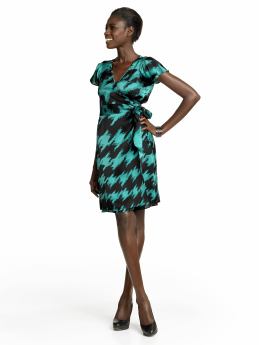 I love the exaggerated houndstooth in teal and black- so very unique. It's a bit too much if you're petite, but don't worry- there are still plenty of statement prints out there that petite gals can rock including this top from Venus:
 "But I want to wear a dress!" I hear you! I hear you! Try this one, tiny ladies. It's also from Venus:
 The asymmetry of the print brings a lot of visual interest and because of its specific placement versus being an all-over print, it works on a smaller frame. Also, the length is key for a shorter gal- it keeps the dress from overwhelming a petite frame. Now, I know there are some tall, fearless ladies out there who want to go all-out and really make a statement. For you, I recommend stripes. Wearing bold stripes says to the world, "I am as confident as a person can get." Try this adorable frock from BCBG Max Azria:
 Another bold option not for the faint of heart, also from BCBG:
Finally, I'd like to wrap up this post with a tribute to Yves Saint Laurent, who made the iconic statement print with his Mondrian dress:


Yes, I took those out of my closet just to take the picture for you- don't you feel special? You can see from the picture on the left that I favor polka dots and florals, but there are a couple of stripes in there as well. Prints can be tough to pull off, depending on your stature. If you are petite, it's important to choose prints that won't overwhelm your frame. You wear the dress, the dress shouldn't wear you! Large prints on a small frame can be tough, but not impossible. Be objective when you look in the mirror- just because you love a print, doesn't mean you should wear it. A nice, tall pair of heels can help you by adding inches to your height, but they are only shoes- not a magic wand. Fall and winter are going to be all about statement prints, so get a few pieces to work into your wardrobe.
If you're average to tall in height, you could easily pull off this dress from Banana Republic:
I love the exaggerated houndstooth in teal and black- so very unique. It's a bit too much if you're petite, but don't worry- there are still plenty of statement prints out there that petite gals can rock including this top from Venus:"But I want to wear a dress!" I hear you! I hear you! Try this one, tiny ladies. It's also from Venus:The asymmetry of the print brings a lot of visual interest and because of its specific placement versus being an all-over print, it works on a smaller frame. Also, the length is key for a shorter gal- it keeps the dress from overwhelming a petite frame. Now, I know there are some tall, fearless ladies out there who want to go all-out and really make a statement. For you, I recommend stripes. Wearing bold stripes says to the world, "I am as confident as a person can get." Try this adorable frock from BCBG Max Azria: Another bold option not for the faint of heart, also from BCBG: Finally, I'd like to wrap up this post with a tribute to Yves Saint Laurent, who made the iconic statement print with his Mondrian dress:
Sunday, August 16, 2009
I couldn't wait...

Booties can be SO hard to pull off- the wrong ones cut you off at the ankle and are SO unflattering. Not so with these by Kelsi Dagger. The downward angle of the top of the bootie is SO flattering from ALL angles. Trust me, I tried them on and oh my gosh did my legs look amazing! And the flower detail is just bonus! LOVE them!
Thursday, August 13, 2009
Housewife style
Hello. My name is Renee and I watch the Real Housewives. Wow. It feels good to have it out in the open like that. However, I want to clarify. I do not DVR the Real Housewives like I do with Project Runway and Top Chef. If I miss an episode of the Housewives, it's not a big deal. In fact, I usually do miss episodes when they initially air. But when those housewives start yelling at each other, flipping tables, pulling wigs, pointing and shouting at each other, I just eat it up. Some might call it trash TV, but I don't know what other kind of TV there is.
What do the Real Housewives have to do with my blog? Well, I'll tell you: they are nothing if not fashionistas. Some have better style than others, but it's clear that they are all very interested in fashion. Sheree, an Atlanta housewife has her own line. Teresa has a degree in fashion. Jill is always having designers make things for her- gowns, jewelry, bags- she loves it all. Bethenny (my favorite housewife) has super cool style and is a personal friend of Ginny Hilfiger. I am not here to discuss any of those housewives tonight. I'm here to discuss the trashiest housewife of them all- Kim. There seems to be a lot of talk about her hair. Her big blonde mane looks so fake and she's gotten a lot of criticism for it- especially when she told her I-thought-I-had-cancer-three-years-ago-but-it-turns-out-I-didn't-and-that's-why-I-wear-a-wig story. (FYI- Cancer doesn't make you lose your hair- chemo does.) In wearing that ridiculous synthetic Barbie-doll wig in every episode, she's set fake hair back indefinitely. Even if you are the kind of person who can wear fake hair without anyone being the wiser, you have to keep it a secret, lest you be thrown in the same category as crazy Kim.
I wear fake hair. I wore my first piece to my friend Lyndsay's wedding. I was part of the ceremony and performed a piece for piano written by the groom for the bride. Aw, aint' that sweet? Well, the wedding was going to be attended by lots of college friends AND professors, so I felt the need to not only sound good, but to look good as well. I went in full beat- lashes, fake hair- the whole nine yards. I've worn fake hair to dinner parties, to work, and out with friends and I'm not embarrassed to admit it. I think that wearing fake hair pieces is an excellent was to spice up your style. I like to keep my hair in a cute bob about chin length. Once it starts growing past my shoudlers, I run out to get it cut. Obviously, short hair is limiting, but if you know how to incorporate a hairpiece, you can still have plenty of variety without growing your hair out.
A popular hairpiece is the Fun Bun by EasiHair. Remember scrunchies? Think of the Fun Bun as a scrunchie made out of synthetic hair. Just pull your natural hair back into a bun- at the nape of your neck, the back of your head, or high on the crown- and then pop the Fun Bun over the bun. It looks best if you layer two Fun Buns on top of each other. At the nape of your neck, it's a nice casual look, the higher you go, the more formal it looks. A Fun Bun at the crown looks like a prom or wedding up-do. (And it takes about 1/10 the time to accomplish.) Even better than the Fun Bun, is a the Magnetic hair wrap, also by EasiHair. No, it doesn't have magnets- that's just the style name. The Magnetic is my personal favorite. It's a comb with two bendable wires attached to it. The wires are covered with the hair. Just like the Fun Bun, you start with a bun, but with Magnetic, the next step is to insert the comb at the base of the bun. After that, you wrap the hair around the bun in whatever style you like. It covers the bun a lot more efficiently than the Fun Bun, while achieving a nearly identical look.

I used to love when Megan Mullally's character Karen Walker on Will & Grace would wear a hair piece. Remember when Jack pulled it off her? Hysterical! I have a friend who wore a big, curly fall to an audition and halfway through the dance combination, the fall flew off her head and landed in front of the audition board! How embarrassing is that?!?!? Hilarious, but embarrassing! But I digress... Another great faux hair line is Jessica Simpson's HairDo. My favorite are the clip-in bangs. How cool is that? I also love the volumizing clip-in-extensions. They are a little pricey, but in terms of comfort and quality these are top notch. With faux hair, you get what you pay for.
I hope this has given you a few faux hair options to look into and I sincerely hope that you do. Don't let that trashy housewife Kim deter you from trying out an extension piece, or a Fun Bun, or even a full wig. Just remember these guidelines:
1.) Go to a salon to have the color matched to your natural hair. The worst tell-tale sign of fake hair is an imperfect color match. Keep in mind that if you buy your faux hair in the winter, it might not match as well in the summer after you've spent some time in the sun!
2.) Never just attach a hairpiece- that's another of the worst tell-tale signs of fake hair. Always work a piece into your own hair- bobby pins and hair pins are helpful when doing this. It only takes a few minutes and the effort is more worthwhile than you can imagine.
3.) Keep your hairpieces clean and well-maintained. There are special shampoos available for synthetic hair. If it's a curly piece, wash it gently, then let it air dry. Limp curls will re-set themselves after a gentle wash. Also, it's perfectly fine to comb your hairpieces if they get a little tangled. Just don't overdo it, or you'll have a frizzy piece that no one will want to see you in.
Good luck working fake hair into your style repertoire- you'll be amazed at how fun it can be once you get started!
Monday, August 10, 2009
Fabric's the key
So much of good design has to do with fabric choice. The right fabric can make or break a garment. This is especially true in my line of work as a costume designer. Dance costumes have to move a certain way depending on the style or type of dance being performed. Some fabric choices help me portray a particular time period or character trait. Some fabrics are chosen because of their durability because some costumes have to hold up to a tremendous amount of wear for long periods of time. The following is a brief tutorial in fabric.
First, the natural fabrics: Cotton, wool, silk, linen, hemp, ramie and jute are all common natural fabrics. Cotton, wool and silk are probably the most common and are used in a huge variety of weaves. People often confuse the weave of a fabric for its fibers. For example, satin is not a type of fabric, but rather a type of weave. Sateen is cotton fabric with a satin weave, but satin can be made with cotton, silk, and a variety of synthetic, or...
Man-made/manufactured fabrics: (Did you like that segue?) Acetate, acrylic, lycra, nylon, polyester, spandex and rayon are all common man-made fabrics. They are all also commonly blended with the aforementioned natural fabrics. Cotton is blended with polyester to create a more durable fabric that wrinkles less (permanent press). Unfortunately, the cotton/poly blend is not nearly as soft and comfortable, hence the recent popularity of 100% cotton garments. Also, cotton/poly blends do not take dye nearly as well as 100% cotton. Spandex seems to be blended with all sorts of other fabrics these days- including cotton. Have you noticed how your jeans are so much more comfortable in the last few years? Check the tag- there's probably a small percentage of spandex or lycra blended with the denim.
But I digress... Obviously man-made fabrics are often much more affordable than natural, hence their popularity. Rayon and polyester both come in various weights and weaves and can closely resemble natural fabrics. Rayon is a common material used to make less-expensive velvet, normally a silk fabric. One of the drawbacks of synthetic fabrics is that they do not take dye very well. This has to do with the manufacturing process, but it's important to keep in mind. When purchasing cotton, you can dye it to suit your garment, but when purchasing a man-made fabric, what you see is often what you get.
I could go on for pages and pages about all the different types of natural and synthetic fabrics and their many variations, but I'll leave you for now- it can be overwhelming, but this little tutorial should be enough to get you started in your fabric education.
First, the natural fabrics: Cotton, wool, silk, linen, hemp, ramie and jute are all common natural fabrics. Cotton, wool and silk are probably the most common and are used in a huge variety of weaves. People often confuse the weave of a fabric for its fibers. For example, satin is not a type of fabric, but rather a type of weave. Sateen is cotton fabric with a satin weave, but satin can be made with cotton, silk, and a variety of synthetic, or...
Man-made/manufactured fabrics: (Did you like that segue?) Acetate, acrylic, lycra, nylon, polyester, spandex and rayon are all common man-made fabrics. They are all also commonly blended with the aforementioned natural fabrics. Cotton is blended with polyester to create a more durable fabric that wrinkles less (permanent press). Unfortunately, the cotton/poly blend is not nearly as soft and comfortable, hence the recent popularity of 100% cotton garments. Also, cotton/poly blends do not take dye nearly as well as 100% cotton. Spandex seems to be blended with all sorts of other fabrics these days- including cotton. Have you noticed how your jeans are so much more comfortable in the last few years? Check the tag- there's probably a small percentage of spandex or lycra blended with the denim.
But I digress... Obviously man-made fabrics are often much more affordable than natural, hence their popularity. Rayon and polyester both come in various weights and weaves and can closely resemble natural fabrics. Rayon is a common material used to make less-expensive velvet, normally a silk fabric. One of the drawbacks of synthetic fabrics is that they do not take dye very well. This has to do with the manufacturing process, but it's important to keep in mind. When purchasing cotton, you can dye it to suit your garment, but when purchasing a man-made fabric, what you see is often what you get.
I could go on for pages and pages about all the different types of natural and synthetic fabrics and their many variations, but I'll leave you for now- it can be overwhelming, but this little tutorial should be enough to get you started in your fabric education.
Saturday, August 8, 2009
The Perfect Suit
Guys, this is another post for you, so pay attention! If you do not own at least one quality suit, get on it. There is no better way to look professional, polished and sleek. But buying a quality suit that fits well and looks right on your body is far easier said than done. There are SO many details to consider, so I'll break it down for you.
Single Breasted vs. Double Breasted: I mentioned this in my Seersucker post, but unless you are pushing 6 feet or there-abouts, do not attempt the double breasted suit. As for single breasted, there are several options for the number of buttons down the front. More on that later.
The lapels: For suits, there are basically two to choose from: notched or peaked. Choose the style that feels best on you, but if they do not lie flat against your chest, the fit of the jacket needs to be adjusted (up). Also, in general, men are often advised to avoid very narrow or very wide lapels. Once again, it's a matter of taste, but that tends to be pretty solid advice. On a tuxedo, you also have the option of a shawl, or rounded collar.
The vents: Generally single vents keep a slim silhouette, while double vents allow you to pull the jacket closer to your body. Double-breasted suit coats usually don't have vents, but there are also single breasted suit coats without vents.
Buttons: The number of buttons on the front of your coat is a matter of taste and fit, but there are rules about which ones to button. With a three-button suit coat, only button the middle one. If there are two buttons, close only the top button. Single button suits are also an option and yes, you may button the single. Very high quality suits also have working buttons on the sleeve. Take a look the next time you see a suit in a nice shop- the real, working buttons are evidence of high quality craftsmanship. It doesn't matter that no one ever unbuttons them to roll his sleeves up, it's more the fact that they CAN open that appeals to some men.
The pockets: A patch pocket is a very informal, almost sporty style of pocket where the pocket itself is sewn to the front of the coat. A flap pocket has a piece of matching fabric that flaps over the opening for the pocket which is inside the coat. This a more formal look than the patch pocket and is also the most common in mens suits. The jetted pocket is the most formal pocket and is mostly seen in formal wear like tuxedos. This type of pocket has a small strip of fabric at the top and bottom of the slit for the pocket. In addition to the two outer pockets, some suits have a third pocket called a ticket pocket located just above the right pocket. It came about as a convenient place to store a train ticket, and has shown up on some suits as of late. When purchasing a new suit, the pockets are sewn shut, make sure to open them carefully with a seam ripper or small scissors, but please don't fill them with bulky items like an ipod, cell phone or wallet. It will ruin the silhouette.
The fabric: Most suits are made of wool and come in a variety of weights, but other popular fabrics include seersucker, cotton, and linen. Also, many of those fabrics, particularly wool are available in a variety of colors and patterns- a navy blue suit is incredibly versatile (but please please please do NOT get one with brass buttons), black is also quite popular and can be dressed up or down. Cotton suits are best in lighter colors such as khaki, or light blue since they are generally reserved for warmer weather. The same goes for linen, but there are always exceptions. Also, prints such as pin-stripe, windowpane plaid, glen-check, and herringbone are all acceptable.
Are you guys feeling overwhelmed? It certainly is a lot of information to take in. My advice: start with a nice navy blue, grey or black suit that fits well. Good fit begins with the shoulders- the seams should fall along your shoulders and the fit should be flattering. It should be snug without looking tight. The sleeves should be long enough to almost hit the knuckle of your thumb while still allowing a bit of sleeve to show. The jacket should pull smoothly across your back when buttoned. If it isn't smooth, the jacket is too tight. Lapels lay flat across your chest. I could write a whole entire post about pants, so I'll try to keep this basic. Flat front is usually best for pants- it's the most flattering, but occassionally a single pleat can help pants drape better, depending on your body type. Just try to avoid pants with multiple pleats. Also, don't be surprised if your suit pants feel different from your jeans- they should. Jeans are always a little tighter in terms of fit. If your suit pants fit like your jeans fit, then you need to get bigger suit pants. The pants should sit at your natural waist- just below your belly button. As for length, the pants should fall an inch above the sole of your shoe- this creates a nice "break" in the front of the pant. Cuffed hems should be reserved for pleated pants.
I hope this crash course in suits has been helpful, but feel free to ask a question in the comments section, or email me. Happy suiting!
Single Breasted vs. Double Breasted: I mentioned this in my Seersucker post, but unless you are pushing 6 feet or there-abouts, do not attempt the double breasted suit. As for single breasted, there are several options for the number of buttons down the front. More on that later.
The lapels: For suits, there are basically two to choose from: notched or peaked. Choose the style that feels best on you, but if they do not lie flat against your chest, the fit of the jacket needs to be adjusted (up). Also, in general, men are often advised to avoid very narrow or very wide lapels. Once again, it's a matter of taste, but that tends to be pretty solid advice. On a tuxedo, you also have the option of a shawl, or rounded collar.
The vents: Generally single vents keep a slim silhouette, while double vents allow you to pull the jacket closer to your body. Double-breasted suit coats usually don't have vents, but there are also single breasted suit coats without vents.
Buttons: The number of buttons on the front of your coat is a matter of taste and fit, but there are rules about which ones to button. With a three-button suit coat, only button the middle one. If there are two buttons, close only the top button. Single button suits are also an option and yes, you may button the single. Very high quality suits also have working buttons on the sleeve. Take a look the next time you see a suit in a nice shop- the real, working buttons are evidence of high quality craftsmanship. It doesn't matter that no one ever unbuttons them to roll his sleeves up, it's more the fact that they CAN open that appeals to some men.
The pockets: A patch pocket is a very informal, almost sporty style of pocket where the pocket itself is sewn to the front of the coat. A flap pocket has a piece of matching fabric that flaps over the opening for the pocket which is inside the coat. This a more formal look than the patch pocket and is also the most common in mens suits. The jetted pocket is the most formal pocket and is mostly seen in formal wear like tuxedos. This type of pocket has a small strip of fabric at the top and bottom of the slit for the pocket. In addition to the two outer pockets, some suits have a third pocket called a ticket pocket located just above the right pocket. It came about as a convenient place to store a train ticket, and has shown up on some suits as of late. When purchasing a new suit, the pockets are sewn shut, make sure to open them carefully with a seam ripper or small scissors, but please don't fill them with bulky items like an ipod, cell phone or wallet. It will ruin the silhouette.
The fabric: Most suits are made of wool and come in a variety of weights, but other popular fabrics include seersucker, cotton, and linen. Also, many of those fabrics, particularly wool are available in a variety of colors and patterns- a navy blue suit is incredibly versatile (but please please please do NOT get one with brass buttons), black is also quite popular and can be dressed up or down. Cotton suits are best in lighter colors such as khaki, or light blue since they are generally reserved for warmer weather. The same goes for linen, but there are always exceptions. Also, prints such as pin-stripe, windowpane plaid, glen-check, and herringbone are all acceptable.
Are you guys feeling overwhelmed? It certainly is a lot of information to take in. My advice: start with a nice navy blue, grey or black suit that fits well. Good fit begins with the shoulders- the seams should fall along your shoulders and the fit should be flattering. It should be snug without looking tight. The sleeves should be long enough to almost hit the knuckle of your thumb while still allowing a bit of sleeve to show. The jacket should pull smoothly across your back when buttoned. If it isn't smooth, the jacket is too tight. Lapels lay flat across your chest. I could write a whole entire post about pants, so I'll try to keep this basic. Flat front is usually best for pants- it's the most flattering, but occassionally a single pleat can help pants drape better, depending on your body type. Just try to avoid pants with multiple pleats. Also, don't be surprised if your suit pants feel different from your jeans- they should. Jeans are always a little tighter in terms of fit. If your suit pants fit like your jeans fit, then you need to get bigger suit pants. The pants should sit at your natural waist- just below your belly button. As for length, the pants should fall an inch above the sole of your shoe- this creates a nice "break" in the front of the pant. Cuffed hems should be reserved for pleated pants.
I hope this crash course in suits has been helpful, but feel free to ask a question in the comments section, or email me. Happy suiting!
Wednesday, August 5, 2009
Diffusion Confusion
A diffision line is a term for a ready-to-wear line of clothing produced by a typically high end designer. It's a line designed to reach the masses and the items therein are significantly less expensive than their runway counterparts. Isaac Mizrahi led the way with discount department store diffusion lines with his line designed for Target. Lots of designers have followed in his footsteps including Vera Wang who has designed a line for Kohls and Alexander McQueen who also designed for Target.
The list of designers with diffusion lines could go on for days- Marc by March Jacobs, D&G by Dolce & Gabbana, and Emporio by Armani to name a few- but you should be aware of the differences in these diffusion lines. No, my friend, not all diffusion lines are created equal, and therefore it is understandable that you might have some diffusion confusion. I hope I can clear some of that confusion up for you.
The easiest way to break it down is to divide the diffusion lines into two types- the first is the type that is still handled by the designer. Marc by Marc Jacobs is a good example of this. The second is the type that is handled by design teams who work with the chain or department store where the product will be sold. Isaac Mizrahi's line for Target is an example of this type of diffusion line.
A mass-produced diffusion line is certainly a lucrative way for a discount department store to create a frenzy in their store- H&M had a run on their Karl Lagerfeld diffusion line, but that's a whole other story. The point I'm trying to make is before you plunk down your credit card, take the time to closely examine the garment you are buying. Some diffusion lines are still made with high-quality craftsmanship, while others are poorly tailored, and use cheap materials. To generalize, it is a safe bet that a diffusion line that is handled by the designer themself will be of a higher quality than one that is handled by a team associated with the chain store. Regardless, when considering a piece from a diffusion line, make sure you are buying it for the right reason- because it looks good on you. If you are buying something simply for the label inside it, you are bound to be disatisfied and will be far less likely to wear it. After all, who can see the inside label except you? Think about it.
Remember that when purchasing a piece from a diffusion line, you are buying something that is most likely mass-produced. When purchasing a designer piece, you are getting something that is made with high quality craftsmanship and it is more than likely a unique piece and sometimes even one-of-a-kind. Isn't that why we like buying designer duds? The idea that we can have something no one, or very few others will also have is appealing! When you purchase from a diffusion line, you may have a "designer" item in your closet, but it's likely not a one-of-a kind item. If that's not important to you, then onward! If you get nothing else from this post, remember that in purchasing ANY item of clothing the most important criterion is how that garment looks on you. Designer pieces, thrift shop or garage sale finds, department store items- any of these can be equally fabulous or fatal if they are not flattering on you.
The list of designers with diffusion lines could go on for days- Marc by March Jacobs, D&G by Dolce & Gabbana, and Emporio by Armani to name a few- but you should be aware of the differences in these diffusion lines. No, my friend, not all diffusion lines are created equal, and therefore it is understandable that you might have some diffusion confusion. I hope I can clear some of that confusion up for you.
The easiest way to break it down is to divide the diffusion lines into two types- the first is the type that is still handled by the designer. Marc by Marc Jacobs is a good example of this. The second is the type that is handled by design teams who work with the chain or department store where the product will be sold. Isaac Mizrahi's line for Target is an example of this type of diffusion line.
A mass-produced diffusion line is certainly a lucrative way for a discount department store to create a frenzy in their store- H&M had a run on their Karl Lagerfeld diffusion line, but that's a whole other story. The point I'm trying to make is before you plunk down your credit card, take the time to closely examine the garment you are buying. Some diffusion lines are still made with high-quality craftsmanship, while others are poorly tailored, and use cheap materials. To generalize, it is a safe bet that a diffusion line that is handled by the designer themself will be of a higher quality than one that is handled by a team associated with the chain store. Regardless, when considering a piece from a diffusion line, make sure you are buying it for the right reason- because it looks good on you. If you are buying something simply for the label inside it, you are bound to be disatisfied and will be far less likely to wear it. After all, who can see the inside label except you? Think about it.
Remember that when purchasing a piece from a diffusion line, you are buying something that is most likely mass-produced. When purchasing a designer piece, you are getting something that is made with high quality craftsmanship and it is more than likely a unique piece and sometimes even one-of-a-kind. Isn't that why we like buying designer duds? The idea that we can have something no one, or very few others will also have is appealing! When you purchase from a diffusion line, you may have a "designer" item in your closet, but it's likely not a one-of-a kind item. If that's not important to you, then onward! If you get nothing else from this post, remember that in purchasing ANY item of clothing the most important criterion is how that garment looks on you. Designer pieces, thrift shop or garage sale finds, department store items- any of these can be equally fabulous or fatal if they are not flattering on you.
Thursday, July 23, 2009
Style Phrase-ology
It's easy to be intimidated by the fashion industry- there are so many designers, constantly changing trends and styles, a plethora of terms to know- it can be difficult! Over the next few weeks, I'll be publishing posts similar to this one in order to cover some of the most common fashion terms. Isn't crazy that there are too many to cover at once? Today, the focus is on terms related to the shape of a garment.
A-line: A skirt shape that is narrow at the top and flares out to the hem, thus creating a shape that resembles the letter "A."
Bateau neck: Also called a boat neck, this high neckline runs straight across the front and back.
Bell sleeve: A sleeve that gradually widens from the shoulder, creating the shape of a bell.
Bias cut: Fabric that is cut on the bias is cut at an angle to the weave of the fibers. This causes the fabric to drape differently than it would if it were cut straight, generally creating a more figure-hugging garment.
Boot cut: A style generally reserved for jeans, boot cut refers to fitted jeans with a slight flare at the bottom of the leg that allows for a tall boot. Flared and bell-bottom jeans are far more exaggerated in their shape.
Cap sleeve: A small sleeve that falls just barely past the shoulder "capping" the top of the arm.
Circle skirt: A skirt that is cut literally in a circle. If you were to lay it out flat, the skirt would form a circle with a much smaller circle in the middle for the waist. Because of the cut, the skirt is voluminous, but lacks gathering at the waist as is often common with full skirts.
Dolman sleeve: A sleeve that is cut from the bodice of a garment that narrows at the wrist. Also referred to as a "batwing sleeve."
Double breasted: A style of jacket in which the front sides overlap each other with a double row of buttons or closures. Very boxy looking and often difficult to pull off. Pea coats are a popular double-breasted jacket.
Dropped waist: A dress or top with a waistline that falls below the natural waist, used to elongate the torso.
Empire: A waistline that starts just below the bust. Very flattering on nearly any body type, but it especially makes the most of a small bust.
Fishtail gown: A dress that is fitted through the bodice down to the knee, then flares outward dramatically in the shape of a fishtail. Also known as a mermaid, trumpet or fit-and-flare.
Halter neck: A neckline that wraps around the back of the neck, often creating a backless, or low back.
Handkerchief: A hemline that falls at angles, creating points rather than a smooth line.
Pencil skirt: A fitted skirt that tapers to the knee.
Pleats: A sewing technique in which the fabric is folded and then stitched at the top, creating more volume. Box pleats are the type generally used on traditional cheerleader skirts, while knife pleats are all folded in the same direction. Pintucks are extremely narrow pleats that are stitched down the length of the fold.
Princess seams: Vertical seams that run along the front and back of a garment, creating a narrow line and taking the shape of the garment in towards the body.
Ruching: When fabric is gathered together and secured in place. It's often a very flattering detail on gowns and dresses, but ruching details can appear almost anywhere.
Scoop neck: A low, U-shaped or rounded neckline.
Shift: A dress with a simple, straight cut.
Split neck: A scoop or rounded neckline that has a center cut-out that forms a small "V."
Square neck: Exactly what it sounds like, this neckline forms the shape of a square.
Straight: Skirts or pants that fall vertically from the hip- no taper or flare.
Sweetheart neck: This graceful neckline forms the shape of the top of a heart over the bust.
Trumpet sleeve: Similar to a bell sleeve, but the flare begins at the elbow and flares out dramatically like the bell of a trumpet.
Tulip skirt: A skirt with fullness at the waist that tapers in at the knee, like the shape of an inverted tulip flower.
Tunic: A top or dress in a boxy shape that has no darts to create shape.
V-neck: Once again, this one looks exactly as you would suspect- the neckline forms the shape of a "V."
A-line: A skirt shape that is narrow at the top and flares out to the hem, thus creating a shape that resembles the letter "A."
Bateau neck: Also called a boat neck, this high neckline runs straight across the front and back.
Bell sleeve: A sleeve that gradually widens from the shoulder, creating the shape of a bell.
Bias cut: Fabric that is cut on the bias is cut at an angle to the weave of the fibers. This causes the fabric to drape differently than it would if it were cut straight, generally creating a more figure-hugging garment.
Boot cut: A style generally reserved for jeans, boot cut refers to fitted jeans with a slight flare at the bottom of the leg that allows for a tall boot. Flared and bell-bottom jeans are far more exaggerated in their shape.
Cap sleeve: A small sleeve that falls just barely past the shoulder "capping" the top of the arm.
Circle skirt: A skirt that is cut literally in a circle. If you were to lay it out flat, the skirt would form a circle with a much smaller circle in the middle for the waist. Because of the cut, the skirt is voluminous, but lacks gathering at the waist as is often common with full skirts.
Dolman sleeve: A sleeve that is cut from the bodice of a garment that narrows at the wrist. Also referred to as a "batwing sleeve."
Double breasted: A style of jacket in which the front sides overlap each other with a double row of buttons or closures. Very boxy looking and often difficult to pull off. Pea coats are a popular double-breasted jacket.
Dropped waist: A dress or top with a waistline that falls below the natural waist, used to elongate the torso.
Empire: A waistline that starts just below the bust. Very flattering on nearly any body type, but it especially makes the most of a small bust.
Fishtail gown: A dress that is fitted through the bodice down to the knee, then flares outward dramatically in the shape of a fishtail. Also known as a mermaid, trumpet or fit-and-flare.
Halter neck: A neckline that wraps around the back of the neck, often creating a backless, or low back.
Handkerchief: A hemline that falls at angles, creating points rather than a smooth line.
Pencil skirt: A fitted skirt that tapers to the knee.
Pleats: A sewing technique in which the fabric is folded and then stitched at the top, creating more volume. Box pleats are the type generally used on traditional cheerleader skirts, while knife pleats are all folded in the same direction. Pintucks are extremely narrow pleats that are stitched down the length of the fold.
Princess seams: Vertical seams that run along the front and back of a garment, creating a narrow line and taking the shape of the garment in towards the body.
Ruching: When fabric is gathered together and secured in place. It's often a very flattering detail on gowns and dresses, but ruching details can appear almost anywhere.
Scoop neck: A low, U-shaped or rounded neckline.
Shift: A dress with a simple, straight cut.
Split neck: A scoop or rounded neckline that has a center cut-out that forms a small "V."
Square neck: Exactly what it sounds like, this neckline forms the shape of a square.
Straight: Skirts or pants that fall vertically from the hip- no taper or flare.
Sweetheart neck: This graceful neckline forms the shape of the top of a heart over the bust.
Trumpet sleeve: Similar to a bell sleeve, but the flare begins at the elbow and flares out dramatically like the bell of a trumpet.
Tulip skirt: A skirt with fullness at the waist that tapers in at the knee, like the shape of an inverted tulip flower.
Tunic: A top or dress in a boxy shape that has no darts to create shape.
V-neck: Once again, this one looks exactly as you would suspect- the neckline forms the shape of a "V."
Wednesday, July 22, 2009
It's a wrap
Today we celebrate an iconic style: the wrap dress. I wore a faux-wrap to work today, so perhaps that's why it's on my mind. I'm sure few women today are aware that Diane von Furstenburg is the woman responsible for making it a truly iconic item. In the early 70's she introduced a knit wrap dress in bright colors and prints popular at the time.
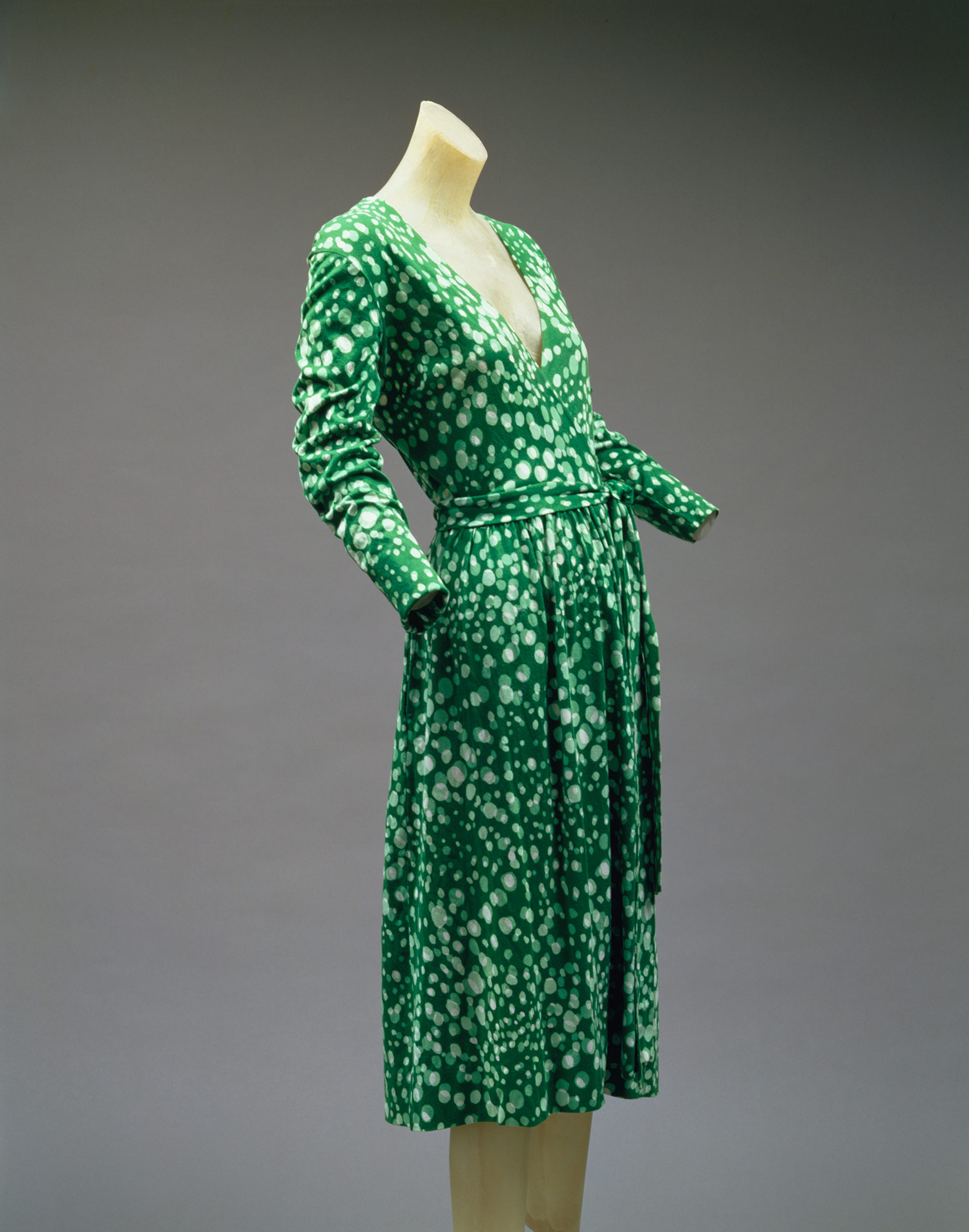 The wrap dress is wonderful because it never goes out of style and it looks good on nearly any body type. All you have to do is find the one that works best for you. My "faux-wrap" today was a basic black nylon jersey, but I'd be comfortable in a print as well. The sleeves hit my elbow and the skirt falls just below my knee. I love the simplicity and versatility of the dress, plus it's incredibly comfortable. It's been more than 30 years since the dress pictured above was in fashion, but DVF's wrap dresses today are not at all dated.
 This bright print has wonderful 70's details- the shorter skirt, the bell detail in the sleeves- and yet it's still very modern.
The wrap dress is wonderful because it never goes out of style and it looks good on nearly any body type. All you have to do is find the one that works best for you. My "faux-wrap" today was a basic black nylon jersey, but I'd be comfortable in a print as well. The sleeves hit my elbow and the skirt falls just below my knee. I love the simplicity and versatility of the dress, plus it's incredibly comfortable. It's been more than 30 years since the dress pictured above was in fashion, but DVF's wrap dresses today are not at all dated.This eyelet version has a vintage feel, but the light fabric, short sleeves and the full skirt feels more like a throwback to the 50's.
This bright print has wonderful 70's details- the shorter skirt, the bell detail in the sleeves- and yet it's still very modern.
I love the way the fabric of this one evokes the feeling of a shirt-dress while the ruffle detail on the neckline and sleeves adds a more feminine touch.

Honestly, DVF's wrap dresses come in too many fabric choices to list them all here, but it would be well worth your time to find the one that works best for you and then add it to your wardrobe.
Subscribe to:
Posts (Atom)